
World
In Japan, divorce splits parents from children. Could a law change end sole custody?
May 24, 2026 International Source: BBC World
An amendment to Japan's Civil Code looks set to allow shared parenting for the first time.
In Japan, divorce splits parents from children. Could a law change end sole custody?
Copyright current_year BBC. All rights reserved. The BBC is not responsible for the content of external sites. Read about our approach to external linking.
Copyright current_year BBC. All rights reserved. The BBC is not responsible for the content of external sites.
Read about our approach to external linking.
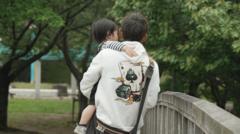
A man dressed up in a hoodie carries a baby in his arms while crossing a bridge in a park.
In Japan, until now only one parent held legal rights over the children after separation
On a weekday afternoon in Japan, John Deng stands near the playground, listening to other children play and laugh.
His own son and daughter are nowhere in sight. He longs for the ordinary moments he once shared with his children: taking them to the park, watching them wake up, and being part of their lives.
Deng, not his real name, is originally from Hong Kong and has lived in Japan for the past 22 years. It's where he built his life, met his former partner, and became a father to two children, an eight-year-old son and a 10-year-old daughter.
But, he says, that life has come undone. His marriage fell apart, and his children were taken away by his ex-partner without warning.
His story is not unusual here. For decades, divorce in Japan often meant a child would lose the presence of one parent entirely. Often in cases like this, custody went to the parent who left with their children first.
Under the old sole custody system, only one parent held legal rights after separation. That meant - regardless of their relationship with the child - the other parent could be forced to disappear from their life, unless the parent with custody grants them access.
But things look set to change. Japan is redefining what "family" looks like after a separation.
On 1 April, 2026, a landmark revision to Japan's Civil Code took effect, allowing divorced couples to share custody of their children. Before parliament approved the amendment in 2024, Japan was the only G7 country that did not recognise the legal concept of joint custody.
a landmark revision to Japan's Civil Code took effect
, allowing divorced couples to share custody of their children. Before parliament approved the amendment in 2024, Japan was the only G7 country that did not recognise the legal concept of joint custody.
"It always shocked me that every time I speak to lawyers in the US and the UK, they say that it's not about win or lose," recalled Seiya Saito, a family lawyer at Setagaya International Law Office based in Tokyo. "It's just focusing on the best interest of children."
A new revision to Japan's Civil Code allows divorced couples to share custody
A group of children in a playground where you can see some adults.
Deng remembers the exact moment he realised he lost the kids. "I felt helpless — sad and also angry about the system that is allowing that to happen," he said quietly. "They mean the world to me."
Now, Deng says he has no choice but to cling onto any opportunity he gets. He maintains two residences, one in Tokyo and the other an hour away, closer to where his children live.
Even so, he is only allowed a few hours of supervised time each month, with no contact in between.
He says his former partner stopped allowing his daughter to communicate with him by phone. That means the absence is not only felt physically, missing birthdays, school recitals, and holidays like Father's Day, but also emotionally.
"I just feel so empty," he said, holding back tears. "I think it's the kids' rights to speak to their parents, both parents, anytime they feel they need to or want to and that's not happening at the moment."
The change in custody law offers some hope for parents like Deng who feel they have been cut off from their children.
It marks one of the most significant changes to Japan's family law in decades.
According to Japan's Ministry of Health, Labor and Welfare, around 38.5% of marriages in Japan ended in divorce in 2024 - the most recent year we have statistics for. That's roughly one in three couples.
That year, women kept custody in more than 86% of cases, while shared custody arrangements accounted for only a fraction of all agreements reached. In total, across Japan, there were more than 164,000 children under the age of 18 who had divorced parents and were impacted by custody arrangements that year.
The new law recognises that children can often benefit from maintaining relationships with both parents, while helping distribute parental responsibility more evenly.
Some however protested against the change, fearing it could bring ex-partners into their childrens' lives
This picture taken on March 29, 2024 shows a group of Japanese women holding a banner saying "Protect children from joint custody after divorce" during a rally outside the National Diet Building in Tokyo against the Japanese government's plan to allow joint custody after divorce.
"I'm 100% sure it's a good change to our society, especially for the children," Saito said.
"For those who are already amicable, and can make decisions together, it's very good for them to have an option to choose joint custody. I think it's a great step forward."
The change also comes as Japan faces a declining birthrate and a rapidly aging population. The demographic trend has intensified calls for the government to support families better and reduce the financial burden for single parents.
While the new law brings Japan more in line with its global peers and gives parents like Deng an opportunity to reunite with their children, it also raises serious concerns.
Critics warn that joint custody could put victims and survivors of domestic violence and abuse in bigger danger, or force continuing or renewing contact with abusive partners.
"There is a risk that those suffering from domestic violence or child abuse may be unable to escape," said Chisato Kitanaka, co-head of All Japan Women's Shelter Network.
She runs the non-profit and warns parents to fully understand the implications of joint custody arrangements in Japan, particularly in cases involving safety concerns.
The law change comes on the back of calls for the government to increase support for families
A couple walks through a shopping street on February 06, 2026 in Tokyo, Japan.
For some families, shared custody raises deep, personal fears.
Taro Suzuki may now be 18, which means he is no longer under his parents' guardianship. But he says watching his mother Ryo suffer years of abuse at the hands of his father has left him traumatised. Both their names have been changed for safety.
"I wish I didn't exist in this world. I even wish my mother and father had never met, and I had never been born," Taro said. "I really think this is a law that shouldn't exist."
Ryo - who describes incidents in which her ex-husband would choke her against a wall, dangling in mid-air, and being dragged along by her hair - is also worried.
"It's really scary. When I got sole custody, I used to think, 'It'll be okay from here on out,' but now there's the possibility that we might be tied together," Ryo said.
She fears it may allow her ex-husband to reapply for joint custody of their 15-year-old daughter, pulling them back into contact.
"I really do think it's a problem. I'll have to live with that anxiety until my daughter becomes an adult."
However, there are legal protections in place for cases where there is risk of abuse or harm to a child's physical or mental well-being.
"If the court is convinced that there are domestic violence issues before the separation, before divorce, then the court must choose sole custody," Saito explained.
Still, some survivors like Ryo worry family courts in Japan will require hard evidence, and she is not convinced the courts will get all the cases right. She says in her experience, there were hardly ever physical signs of abuse because her ex-husband was cautious about leaving marks.
For now, the law sits in the middle of a delicate balance, between protecting vulnerable parents and preserving a child's relationship with both.
Back at the neighbourhood park, Deng is hopeful the new law may allow him to once again be part of his children's everyday lives.
"The fact that they're not physically here with me just makes me feel sad," he said. "It's something that no parent should face."
Eve Simmons, sporting long brown hair and a blue dress, is smiling while sitting on an orange sofa
My break-up blindsided me. Here's how to tell if your relationship isn't working
Overcoming the stigma of an Indian divorce
Sanae Takaichi is popular - but inflation and a diplomatic row with China weigh on voters' minds.
Police are investigating the facility's safety, after owners allegedly admitted that the emergency alarm had been switched off for two years.
Geoff Martel, from Guernsey, says he could not have asked for more from his teammates.
The temple has moved the flame to a different location and authorities said the fire may have been caused by it, according to Japan Times.
Two US nationals have been arrested after one jumped the fence of the monkey, who went viral online, police say.
Brighton winger Kaoru Mitoma is left out of Japan's 26-man squad for the World Cup after sustaining a hamstring injury last weekend.
The effective closure of the Strait of Hormuz has severely disrupted global supplies of energy and petrochemicals.
Kikuo Hatakeyama, 72, has served as the mayor of Hachirogata in north-east Japan since 2008, but fell ill in February.