
World
Ebola outbreak may be spreading faster than first thought, WHO doctor warns
May 20, 2026 International Source: BBC World
Hundreds of cases are suspected in central Africa but experts fear the actual number may be much higher.
'Ebola has tortured us': Fear as DR Congo outbreak spreads
Copyright current_year BBC. All rights reserved. The BBC is not responsible for the content of external sites. Read about our approach to external linking.
Copyright current_year BBC. All rights reserved. The BBC is not responsible for the content of external sites.
Read about our approach to external linking.
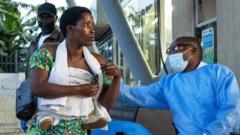
A Congolese health worker in blue medical gowns checks the temperature of a woman in green carrying a baby at the Grande Barrier border following confirmation of an Ebola outbreak in the Congo
Ebola outbreak may be spreading faster than first thought, WHO doctor warns
People in DR Congo have told the BBC they are scared and unsure what to do to protect themselves and their families
'Bigboy' stands outside near a motorbike
People living close to the epicentre of a deadly Ebola outbreak have told the BBC of their fear, as the World Health Organization (WHO) warned cases may be spreading faster than originally thought.
One man in the Democratic Republic of Congo's northeastern Ituri province said infected people were dying "very fast", adding: "Ebola has tortured us."
The virus is believed to have killed 136 people in the DR Congo, officials say, with more than 514 cases now suspected in the country. One person has died in neighbouring Uganda.
The WHO's Dr Anne Ancia told the BBC that the more the UN agency investigates the outbreak, the clearer it becomes cases have spread to other areas.
Modelling by the London-based MRC Centre for Global Infectious Disease Analysis released on Monday suggested there had been "substantial" under-detection, and that it could not rule out there had already been more than 1,000 cases.
The study suggested that the current outbreak is "larger than currently ascertained" and that its "true magnitude remains uncertain".
A man who spoke to BBC News and identified himself as Bigboy said people are "really scared" and doing what they can to protect themselves.
He said locals are taking precautions such as washing hands with clean water, but added that he wished they could get access to other protective supplies such as face masks.
Another Ituri local, Alfred Giza, said people in the community are aware of the threat and waiting to receive face masks to protect themselves, but that he would not know what to do if a family member or friend contracted the disease.
Map of eastern DR Congo and Uganda showing areas affected by an Ebola outbreak. Shaded red regions mark locations with reported cases, concentrated in Ituri province, including Mongwalu, Rwampara, Nyakunde, and nearby Bunia, identified as the site of the first suspected case. Additional smaller affected areas are shown around Butembo, Goma near the Rwanda border, and a location near Kampala in Uganda, where cases were confirmed in travellers from DR Congo. A locator inset highlights the region within Africa.
The Red Cross warned that Ebola can escalate quickly if cases are not identified early, communities lack information and health systems are overwhelmed, adding "we are seeing all those conditions" in the current outbreak.
On Tuesday, DR Congo President Félix Tshisekedi called for "calm" and urged Congolese citizens to remain vigilant, after holding a crisis meeting on Monday evening.
WHO chief Tedros Adhanom Ghebreyesus, who declared the outbreak an international emergency last week, said he was "deeply concerned about the scale and speed of the epidemic".
He declared the emergency late on Saturday night - before the WHO's emergency committee met to assess the situation and recommend priority medical interventions, which it is due to do soon.
The cash-strapped organisation has already released almost $4m (£3m) to combat the outbreak - but much more may be needed.
The outbreak is taking place in a region which has suffered years of conflict, with hospitals and clinics damaged or destroyed, and millions fleeing their homes. Most are living in unsanitary conditions.
There are also more than 11,000 refugees who have fled fighting in South Sudan, and big population movements among people seeking work in local gold mines.
A person wearing a mask and peach headwrap is having their temperature checked with a contactless thermometer near their ear. it reads 36.3 degrees.
'Ebola has tortured us': Fear grips eastern DR Congo as deadly virus spreads
A medic checks the temperature of a woman, using a contactless infrared thermometer. Only the arm of the medic, who is wearing white, is shown. The woman having her temperature checked has her hair in braids. She is wearing a bright blue top with a pattern and is standing next to a blue wooden door with a white and blue building in the background.
What is Ebola and why is stopping the latest outbreak so difficult?
American who contracted Ebola in DR Congo evacuated for treatment
It is feared the outbreak may have been ongoing for several weeks before it was first detected on 24 April.
There is no vaccine for the strain of Ebola virus fuelling the latest rise in cases, but the WHO is evaluating whether other drugs may provide protection.
Speaking to BBC Newsday, Ancia said DR Congo's Ituri province was a "very unsecured area with lots of movement of population", making it difficult for the agency to investigate and help control the disease.
She continued: "The more we are investigating this outbreak, the more we realise that it has already disseminated at least a little bit across border and also in other provinces."
WHO is sending tonnes of health supplies to DR Congo, including personal protective equipment (PPE) and medicine
A woman inspects large boxes of aid on shipment pallets
The outbreak has spread to the province of South Kivu, where the population has been affected by a humanitarian crisis for many years, she added.
There has also been a case in eastern DR Congo's biggest city, Goma, which has a population of around 850,000 people and is under the control of Rwandan-backed rebels.
High levels of insecurity in several provinces mean people move around often, increasing the risk and spread of the virus, she said.
Several African countries are taking precautions by tightening border screenings and preparing health facilities. Neighbouring Rwanda has also closed its borders with the DR Congo. Uganda has told people to avoid hugging and shaking hands.
An American citizen, believed to be missionary group doctor Peter Stafford, was evacuated from the DR Congo after developing symptoms over the weekend.
believed to be missionary group doctor Peter Stafford
, was evacuated from the DR Congo after developing symptoms over the weekend.
Germany's health ministry told the BBC a US citizen was taken to the country for treatment.
The US Centers for Disease Control and Prevention (CDC) said at least six other Americans who were exposed were also being evacuated. On Tuesday, the agency said it was in the process of moving the Americans to Germany and the Czech Republic, where they would be monitored for symptoms in quarantine.
The WHO and other agencies are working with governments and communities to try to stop the spread of the virus, urging residents to follow preventative measures and report to the nearest health facility if they experience any symptoms.
A graphic explaining the different symptoms of Ebola and how it attacks the human body
Ebola is caused by a virus and initially causes symptoms similar to the flu, with fever, headache and tiredness.
As the disease progresses, vomiting and diarrhoea develop and it can lead to organ failure. Some, but not all, patients develop internal and external bleeding.
The virus spreads from one person to another by contact with infected bodily fluids such as blood or vomit.
The Bundibugyo strain fuelling this rise in cases is rare, and has previously only caused two outbreaks, when it killed about a third of those infected.
Between 2014 and 2016, more than 28,600 people were infected by Ebola in West Africa, the largest outbreak of the virus since its discovery in 1976.
It was caused by the Zaire strain, for which there is an approved vaccine.
The disease spread to a number of countries in West Africa and beyond, including Guinea, Sierra Leone, the US, UK and Italy, killing 11,325 people.
Have you been affected by the issues raised in this story? Let us know.
Please include a contact number if you are willing to speak to a BBC journalist. You can also get in touch in the following ways: Email: yourvoice@bbc.co.uk Send us images or video Tweet: @BBC_HaveYourSay And you can send us a video note by using this link .
A visitor washes his hands before entering Kyeshero Hospital at a checkpoint for hand washing and temperature screening for all visitors and patients entering Kyeshero Hospital, as part of Ebola prevention measures in Goma on May 18, 2026.
At least 131 dead in Ebola outbreak in DR Congo, official says
The image shows three individuals in the foreground wearing full-body protective suits in bright yellow, along with white hoods, face masks, and gloves. Two of the individuals are helping adjust or fasten the protective gear of a third person, focusing on securing the hood or mask around the head and neck area. The setting is outdoors, with a blurred crowd of people and buildings visible in the background, suggesting a public or community environment. Additional people in the background are also wearing protective clothing. The lighting is natural daylight, and the scene emphasizes careful preparation and attention to safety procedures.
How worrying is the Ebola outbreak in DR Congo?
The agency added that the outbreak, with around 246 cases and 80 deaths, does not meet the criteria of pandemic emergency.
A BBC investigation exposed how scammers posted social content of dogs in distress to dupe donors into giving money.
Yoweri Museveni, 81, won disputed elections in January to extend his 40-year rule.
An outbreak of Ebola in DR Congo involves a rare strain and is in an area affected by conflict.
The former power minister was sentenced to 75 years in jail in absentia earlier this month.
The group for 15-19 year olds can help them realise "I'm not alone" and bond with others, the charity says.
Vaccine available from 1 June to eligible young people in Weymouth, Portland and Chickerell.
Robotic surgery requires only very small incisions and uses miniaturised cameras and instruments, controlled remotely by a surgeon.