World
Red Cross volunteers die from suspected Ebola in DR Congo
May 23, 2026 International Source: BBC World
They are thought to have caught the virus before the outbreak was identified, the Red Cross says.
Red Cross volunteers die from suspected Ebola in DR Congo
Copyright current_year BBC. All rights reserved. The BBC is not responsible for the content of external sites. Read about our approach to external linking.
Copyright current_year BBC. All rights reserved. The BBC is not responsible for the content of external sites.
Read about our approach to external linking.
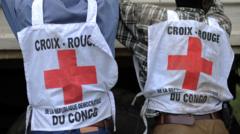
The volunteers are thought to have been infected before the outbreak had been identified, the Red Cross said (file photo)
Two individuals are pictured from behind wearing Red Cross tabards.The tabards read "croix-rouge de la republic Democratique du Congo"
Three Red Cross volunteers died in the Democratic Republic of Congo from suspected Ebola likely caught while managing dead bodies, the organisation has said.
They are believed to have contracted Ebola on 27 March while working in the eastern region of Ituri on a project unrelated to the virus, before the outbreak was identified.
The volunteers are thought to be among the first to die in DR Congo's Ebola outbreak, which has resulted in more than 170 suspected deaths and 750 suspected cases.
The International Federation of Red Cross and Red Crescent Societies (IFRC) said they had died after serving their communities "with courage and humanity".
The outbreak "had not been identified" when Alikana Udumusi Augustin, Sezabo Katanabo and Ajiko Chandiru Viviane were working with the dead bodies, the IFRC said.
They died between 5 and 16 May and had been working in the town of Mongbwalu, which is now considered the epicentre of the outbreak.
On Friday, the World Health Organization (WHO) raised the public health risk from the virus in DR Congo from "high" to "very high".
On Friday, the World Health Organization (WHO)
from the virus in DR Congo from "high" to "very high".
WHO chief Dr Tedros Adhanom Ghebreyesus also said the risk in the wider region in Africa was "high" but remained "low" globally.
The outbreak involves a rare species of Ebola, known as Bundibugyo, which has no proven vaccine and kills about a third of those infected.
A medic checks the temperature of a woman, using a contactless infrared thermometer. Only the arm of the medic, who is wearing white, is shown. The woman having her temperature checked has her hair in braids. She is wearing a bright blue top with a pattern and is standing next to a blue wooden door with a white and blue building in the background.
What is Ebola and why is stopping the latest outbreak so difficult?
BBC reporter Emery Makumeno in front of DRC map and flag
Why does Ebola keep on occurring in DR Congo?
Ebola itself was first discovered in what is now the DRC in 1976 and the country is now facing its 17th outbreak. So why does DR Congo keep facing disease outbreaks?
Health experts warn that touching the body of someone who died from Ebola can spread the virus because bodily fluids remain highly infectious after death.
DR Congo's neighbour, Uganda, has also reported cases of the virus. On Saturday, its health ministry confirmed three new cases - bringing the number of confirmed infections there to five.
The same day, the African Centres for Disease Control warned 10 other countries on the continent were at risk of being affected: Angola, Burundi, the Central African Republic, the Republic of Congo, Ethiopia, Kenya, Rwanda, South Sudan, Tanzania and Zambia.
In DR Congo, Médecins Sans Frontières (MSF) said a tent it had provided in Mongbwalu to treat Ebola patients was burnt on Friday.
"Understandably, there are still many uncertainties and fears among the community in this rapidly evolving context," it said.
"This incident highlights just how critical sustained community engagement and trust building are."
The previous day, an angry crowd elsewhere in Ituri set alight part of a hospital after the family and friends of a young man thought to have died from Ebola were prevented from taking his body away for burial.
an angry crowd elsewhere in Ituri set alight part of a hospital
after the family and friends of a young man thought to have died from Ebola were prevented from taking his body away for burial.
Along with Ituri, cases have been detected in the North and South Kivu regions. Parts of the two eastern areas are under the control of the M23, a rebel group that controls parts of the region - which has brought additional difficulties in dealing with Ebola.
A person wearing a mask and peach headwrap is having their temperature checked with a contactless thermometer near their ear. it reads 36.3 degrees.
'Ebola has tortured us': Fear grips eastern DR Congo as deadly virus spreads
The image depicts a group of individuals dressed in full-body protective suits, complete with face masks, goggles, and bright orange gloves. Their attire suggests they are engaged in a high-risk operation, likely involving hazardous materials or infectious disease control. They are working outdoors in what appears to be a forested or rural environment, with greenery and natural terrain surrounding them. The scene conveys a sense of urgency and seriousness, as the protective gear is designed to minimise exposure to dangerous contaminants.
'Speed, money and compassion' - lessons from an Ebola survivor and other experts
The image shows a laboratory setting with bright, clean lighting and smooth surfaces. A person is wearing protective clothing, including a blue gown, gloves, a face mask, and a head covering. The person is using a pipette to transfer liquid into a small tube placed in a rack. A clear protective barrier is positioned in front of the workspace, suggesting a sterile or controlled environment. The background includes lab equipment and reflective surfaces, reinforcing the clinical and scientific atmosphere.
UK scientists developing Ebola vaccine that could be ready for trials in months
A woman looking at her mobile phone and the graphic BBC News Africa
Go to BBCAfrica.com for more news from the African continent.
for more news from the African continent.
Follow us on Twitter @BBCAfrica, on Facebook at BBC Africa or on Instagram at bbcafrica
Hundreds of cases are suspected in central Africa but experts fear the actual number may be much higher.
The agency added that the outbreak, with around 246 cases and 80 deaths, does not meet the criteria of pandemic emergency.
A BBC investigation exposed how scammers posted social content of dogs in distress to dupe donors into giving money.
Bassirou Diomaye Faye also dissolved the government, creating uncertainty amid a debt crisis in the country.
Those caught up in West Africa's Ebola outbreak a decade ago on how best to tackle the current epidemic.
The head of the UN health agency says the risk in the wider region is "high", but it remains "low" at the global level.
The rare species of Ebola involved - known as Bundibugyo - kills around a third of those infected and has no proven vaccine yet.
Grieving relatives and friends of a suspected Ebola victim were prevented from taking his body for burial.